
No Accounting for Taste
Food, Flavor, and the English Language

For centuries, the Pirahã people lived in obscurity, hunting and gathering along the Maici River in the Amazon rainforest until missionary, and later linguist, Daniel Everett arrived in the late 1970s. Everett became the first outsider to successfully study the Pirahã language, leading to an unlikely development that sparked a noted controversy: Everett claimed that the simplicity of Pirahã, including its lack of vocabulary related to color, disproved Noam Chomsky’s linguistic theory of universal grammar; that is, that all languages on Earth share certain grammatical rules dictated by our neural biology.1
While Pirahã doesn’t have words for colors like “red” and “blue,” it does have “dark” and “light,” and otherwise makes do by use of comparison; i.e. a blue flower might be described as being “sky-colored” or a sunset as “fire-colored.” It might seem strange that a language could lack a word for red – after all, the color of blood is distinct, unmistakable, and signals danger. But it is the fact that there is little else in the natural world so vividly red that makes it undeserving of its own conceptual category. In other words, “blood-colored” is a sufficient word for “red” in an environment where red is scarce.
In general, the languages of hunter-gatherer societies tend to deprioritize words related to color and shape in contrast with their counterparts spoken in agrarian or post-agrarian societies. Instead, studies have shown that hunter-gatherers are better both at naming smells and identifying them accurately, reflecting the importance of smell in determining if foraged foods are safe to eat. After all, in large-scale agrarian societies, food safety is entrusted to a select few, while visual communication is prioritized as a means of organizing and informing the masses.
Consequently, English almost completely lacks a vocabulary for smells, preferring to borrow from the realm of taste (as in “sweet-smelling”) with only a couple of exceptions like “musty” and “rancid.” By coincidence or not, smell has been considered the least important of the five senses in Western culture since Plato derided olfactory function as “base” and “half-formed.” Neurologist Jay Gottfried has suggested that the reason smell is difficult to encode linguistically is related to the fact that, unlike our other senses, it bypasses the thalamus and is processed by the limbic system, which is responsible for long-term memory and atavistic emotional states, like hunger, fear, and anger. If Gottfried is to be believed, then Plato might have actually been right about smell, though it’s not the only percept that English speakers struggle to describe.
English, like Pirahã, often relies on comparison to serve the function of descriptive adjectives. Consider the way that the taste of a particular pinot noir might be marketed to you by a sommelier, and you will inevitably be told that it is “chocolatey,” “velvety,” or “earthy,” despite the fact that it does not contain chocolate, velvet, or earth. English broadly lacks a word that corresponds to the Romanian “amărui,” which is used to describe food or drink that is pleasantly bitter, like wine, coffee, and licorice.
Similarly, there are no English counterparts for the words that describe different flavors of meat in Italian, with the exception of “gamey,” which has a negative connotation and usually only applies to duck and venison. Though there is reason to believe that our taste buds can detect lipids in addition to saltiness, sweetness, sourness, bitterness, and umami, we lack a word analogous to the French “onctueux,” which is used for food that is fatty in a pleasant way, like butter and salmon. Of course, “umami,” the rich and savory quality of broth and cooked meat, is itself a loanword English borrowed from Japanese.
English is even more limited in terms of texture-related vocabulary – there is no equivalent for the Taiwanese Q, which describes food that is pleasantly chewy or springy, like calamari or gummy candy. More generally, we lack words to express the appeal of different kinds of seafood, like the slipperiness of oysters and the texture of fish, that is, the way it disintegrates in the mouth more easily than meat. “Crunchy” does most of the heavy lifting for texture, yet fails to capture the difference between the initial bite of a cucumber and the texture of fried food in the way that the Korean 아삭하다 (asakhada) and 바삭하다 (basakhada) do, respectively.
The fact that we lack flavor-related vocabulary is strange in light of the average American diet. Indeed, the diversity of the foods we eat is reflected by their etymology – with the exception of “beer,” “bread,” “ham,” “apple,” and a handful of others, the vast majority of the foods we eat were introduced into the diet of English speakers within recent history, including staples like “yogurt” (Turkish), “avocado” (Nahuatl), “banana” (Wolof), and “cereal” (French via Latin). If we’ve embraced foreign foods and even appropriated their names, why are flavor-related adjectives so lacking in comparison to those of languages like Chinese, Khmer, and Georgian? One reason that the introduction of foreign foods has failed to give us the vocabulary to describe them is that most loanwords from other languages are nouns, which are easier to integrate into a language than other parts of speech. As a result, while global trade networks brought foreign food-nouns to Western society, we were stuck describing them with the same handful of words as our linguistic ancestors.
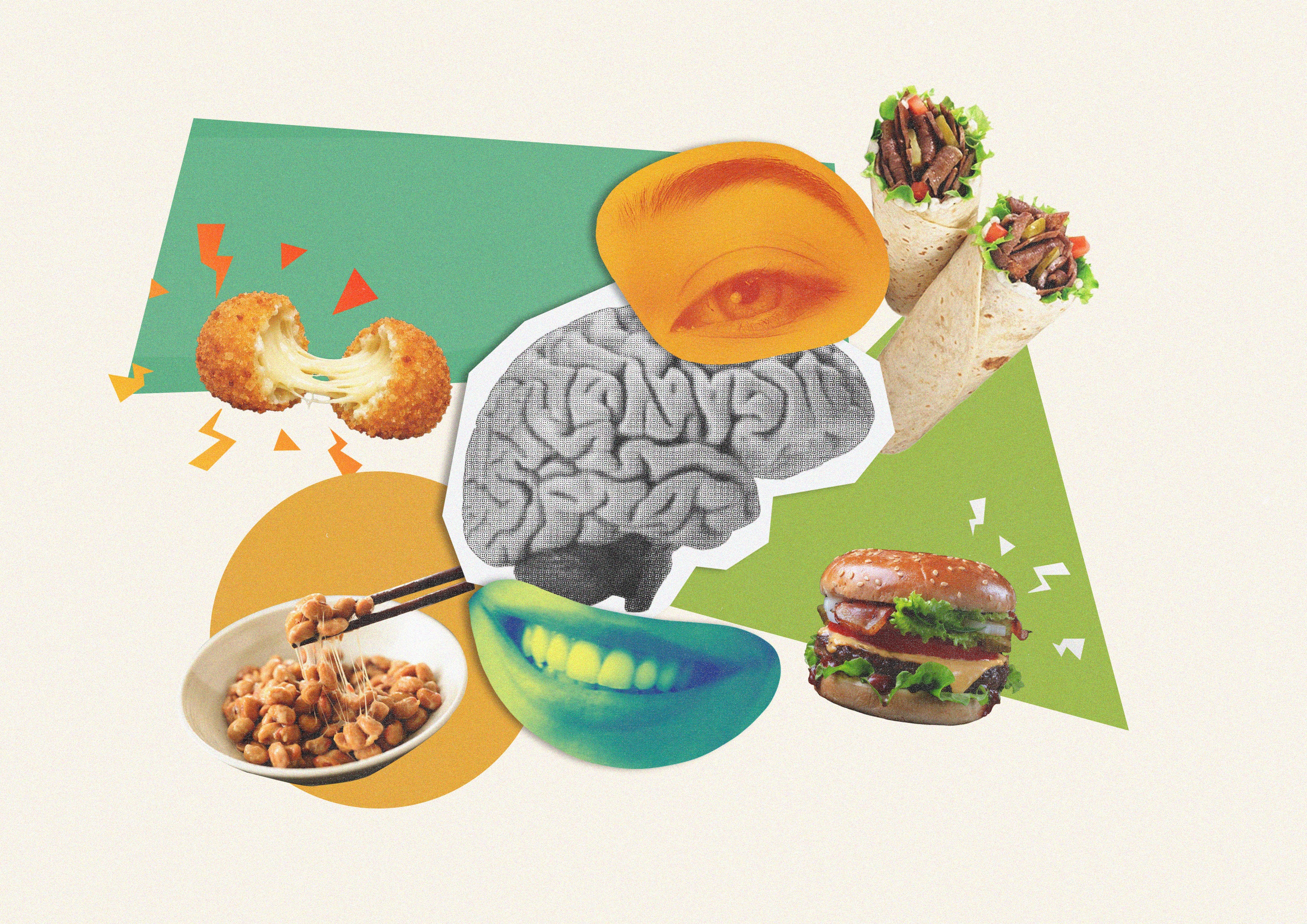
Though the modern variety of options for breakfast, lunch, and dinner would boggle the mind of a 10th century Londoner, our palates have been dulled by a language that lacks the ability to characterize them. This could easily be one reason why American diners struggle with food that transcends the crunchy-creamy dichotomy. In the era of global cuisine, English’s limitations are regrettable—without a robust vocabulary for flavor, we are less able to conceive of, and thus appreciate, what is meant to be enjoyable about food from outside of our cultural sphere.
Further Reading
Lehrer, A. (2009). Wine and Conversation (2nd ed.). Oxford University Press.
Tschann, J. (2023). Romaine Wasn’t Built in a Day: The Delightful History of Food Language. Voracious.
Jurafsky, D. (2014). The Language of Food: A Linguist Reads the Menu (illustrated ed.). W. W. Norton & Company.
Gerhardt, C. (2013). “Language and Food - Food and Language”. In: Cornelia Gerhardt, Maximiliane Frobenius & Susanne Ley (eds.), Culinary linguistics: The Chef’s Special (Culture and Language Use: Studies in Anthropological Linguistics 10), 3-50, 319-344. Amsterdam et al.: John Benjamins. https://doi.org/10.1075/clu.10.01ger
The main feature of the language that violates the tenets of Chomsky’s theory of universal grammar is the lack of relative clauses and recursion. This means that a Pirahã speaker could not say, “The woman in the dress is walking toward the tree;” only, “The woman wears a dress. She walks towards the tree.”